

Plant Wisdom
The plants growing around us have stories to tell.
Some have nourished families through long winters. Others have soothed aching muscles, supported pollinators, or quietly flourished along forgotten trails for centuries. Every season offers an opportunity to slow down, pay attention, and rediscover the wisdom that has always been present in the natural world.
This is a place to explore the plants of Northern Ontario through curiosity, respect, and relationship. Together, we'll learn how to identify native and naturalized plants, understand their traditional uses, appreciate their role within the ecosystem, and practice ethical, sustainable foraging that honours both the land and future generations.
Whether you're taking your first steps into plant knowledge or continuing a lifelong journey, I hope these writings encourage you to see the landscape with fresh eyes and a deeper sense of connection.
Every plant has a story.
Perhaps one is waiting to meet you.

Why Plant Wisdom Matters

Plants are more than ingredients—they are teachers.
Long before books, people learned by observing the land.
They watched which plants emerged first in spring, which flowers welcomed the pollinators, which berries ripened in late summer, and which roots sustained life through winter. This knowledge was passed from one generation to the next through careful observation, experience, and deep respect for the natural world.
Plant wisdom isn't about collecting as many herbs as possible or searching for a miracle cure. It's about slowing down enough to notice. To learn the names of the plants around us. To understand their place in the ecosystem. To appreciate the relationships that exist between the land, the wildlife, the seasons, and ourselves.
The more time we spend with the plants, the more they invite us to see the world differently—with patience, curiosity, gratitude, and wonder.
My hope is that these writings encourage you not only to learn about plants, but to build a lifelong relationship with them.
The Hedgekeeper's Journal
Every plant has a story. Every season offers a lesson.
Welcome to The Hedgekeeper's Journal—a growing collection of field notes inspired by the forests, fields, wetlands, and shorelines of Northern Ontario.
Each journal entry explores a single plant through careful observation, traditional knowledge, and a deep respect for the natural world. Together we'll learn how to identify plants, understand their place within the ecosystem, explore their historical and traditional uses, and practice ethical, sustainable foraging.
Whether we're discovering a familiar roadside wildflower or a hidden woodland treasure, every plant invites us to slow down, pay attention, and deepen our relationship with the land around us.
This journal is not intended to replace professional medical advice or encourage self-treatment. Instead, it is an invitation to learn, observe, and reconnect with the remarkable plants that have quietly shared this landscape with us for generations.
I hope each entry inspires you to step outside, notice something new, and continue your own journey of discovery.
Field Notes: Wild Sarsaparilla (Aralia nudicaulis)
"Sometimes the most remarkable plants are the ones we walk past without ever noticing."
Hidden beneath the canopy of Northern Ontario's forests, Wild Sarsaparilla quietly spreads across the woodland floor. Although often overlooked, this native plant has been valued for generations for its traditional uses, ecological importance, and gentle beauty.
Despite its name, Wild Sarsaparilla isn't closely related to the tropical sarsaparilla used in old-fashioned soft drinks. Instead, it belongs to the ginseng family and has long been appreciated in traditional herbal practices throughout North America.
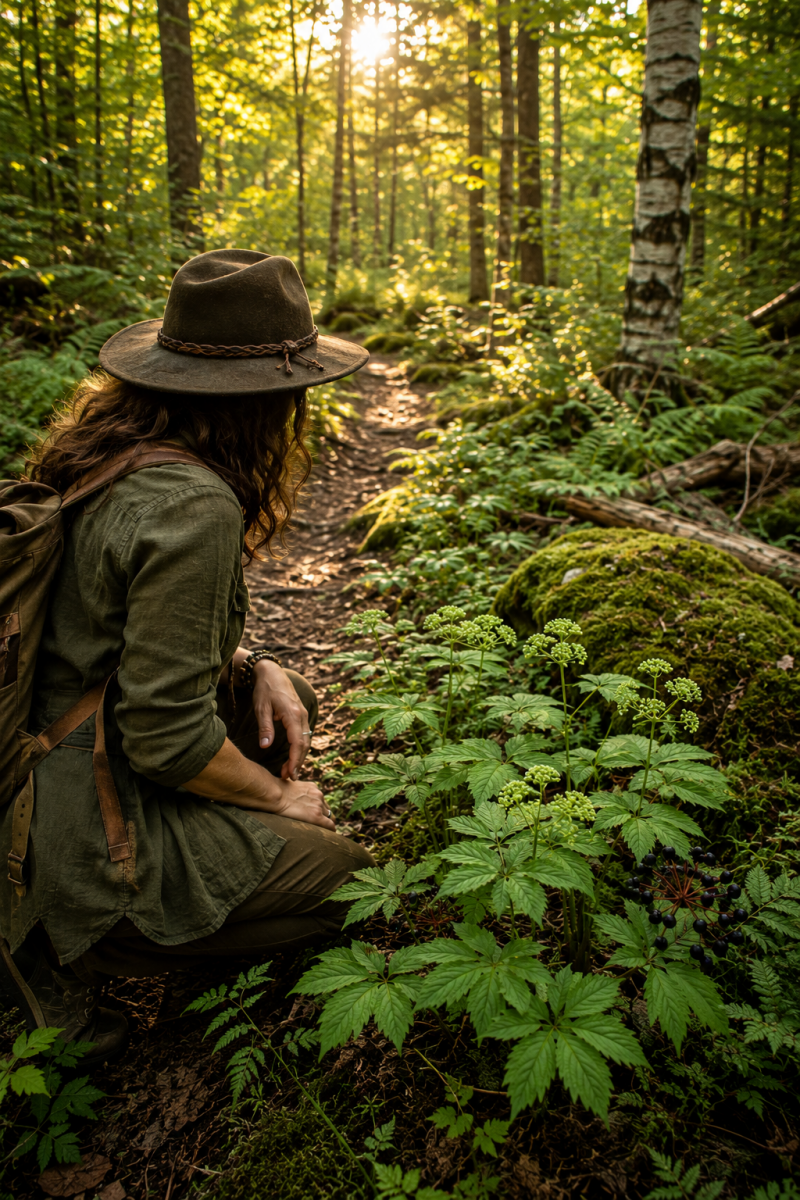
One of the easiest ways to recognize Wild Sarsaparilla is by its single stem dividing into three graceful branches, each holding a cluster of leaflets that create an umbrella-like appearance. In early summer, delicate greenish-white flowers bloom beneath the leaves, later developing into small, dark blue berries enjoyed by many woodland birds and animals.
As with all wild plants, correct identification is essential before harvesting. Learning to observe a plant through every season helps us understand not only how it grows, but also the important role it plays within the forest ecosystem.
For me, Wild Sarsaparilla is a reminder that some of nature's greatest gifts aren't the loudest or the most obvious. They quietly wait for those willing to slow down, look closely, and learn.

Identification

How to Recognize Wild Sarsaparilla
Wild Sarsaparilla (Aralia nudicaulis) is a native woodland perennial found throughout much of Northern Ontario. Although common, it often goes unnoticed because its flowers bloom beneath the leaves rather than above them.
Identification Features
- Height: Typically 20–60 cm (8–24 inches) tall.
- Leaves: A single stem divides into three branches, each bearing three to five finely toothed leaflets, creating a graceful umbrella-like appearance.
- Flowers: Small, greenish-white flowers form rounded clusters hidden beneath the leaves in late spring to early summer.
- Fruit: By late summer, the flowers develop into clusters of dark blue to nearly black berries that provide food for birds and other wildlife.
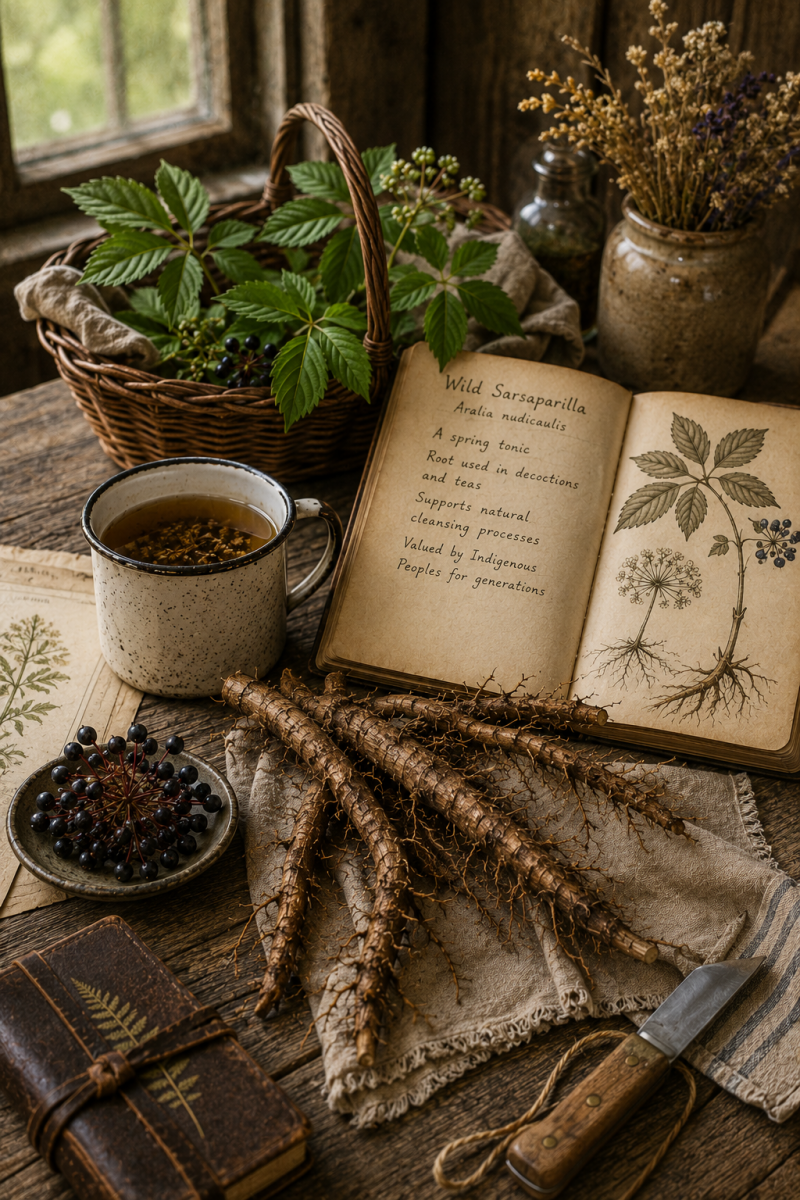
- Roots: The underground rhizome has a distinctive aromatic scent and has been traditionally used in herbal practices.
Where You'll Find It
Wild Sarsaparilla thrives in:
- Mixed hardwood forests
- Deciduous woodlands
- Mossy forest floors
- Well-drained, slightly acidic soils
- Shaded trails and woodland edges
It often grows in large colonies, carpeting sections of the forest floor beneath maples, birches, poplars, and pines.
Traditional Uses
A Plant with a Long History
For generations, Wild Sarsaparilla (Aralia nudicaulis) has been valued by Indigenous Peoples and later by early settlers throughout eastern and central North America. Its aromatic roots were traditionally prepared in a variety of ways and appreciated as part of everyday wellness practices.
Historically, Wild Sarsaparilla has been used to prepare teas, decoctions, and tonics. Traditional herbalists often turned to the root as a spring botanical, believing it supported the body's natural processes during seasonal transitions. It was also commonly included in herbal preparations intended to promote general wellbeing.
Beyond its practical uses, Wild Sarsaparilla represents the close relationship people once shared with the forests around them. Knowledge of when to harvest, how much to take, and how to prepare the plant was passed from one generation to the next through careful observation and lived experience.
Today, many people continue to appreciate Wild Sarsaparilla as part of North America's rich herbal heritage. While modern research continues to explore many traditional plants, this journal celebrates their historical significance and the enduring connection between people and the natural world.
Please note: The information shared here is intended for educational purposes only and is not medical advice. Always consult a qualified healthcare professional before using any wild plant for medicinal purposes.
Wildlife & Ecological Value

More Than Medicine
Wild Sarsaparilla is more than a medicinal plant—it is an important part of the woodland community.
In early summer, its small, greenish-white flowers provide nectar and pollen for a variety of native bees, flies, beetles, and other pollinating insects. Although the flowers are modest in appearance, they offer an important food source at a time when many woodland plants are in bloom.
As the season progresses, the flowers give way to clusters of dark blue to nearly black berries. These fruits become an important late-summer food source for birds and small mammals, helping to sustain wildlife as they prepare for the changing seasons.
Beneath the forest floor, Wild Sarsaparilla's spreading rhizomes help stabilize the soil and contribute to the rich diversity of the woodland understory. Healthy colonies provide shelter for insects and help create the layered habitat that supports a thriving forest ecosystem.
Every plant has a role to play. Learning to recognize those relationships reminds us that foraging isn't simply about what we take from the land—it's also about understanding what the land gives to countless other living things.
Did You Know?
Wild Sarsaparilla is a native species throughout much of Canada and eastern North America, making it an important part of the natural biodiversity of our forests.
Sustainable Harvesting
Harvest with Gratitude, Leave with Respect
Learning to harvest wild plants is about much more than gathering what we need. It is a practice rooted in observation, patience, and respect for the living communities that depend on these plants.
Although Wild Sarsaparilla is common in many parts of Northern Ontario, every population deserves care. Before harvesting, take time to observe the health of the colony. Is it thriving? Are pollinators actively visiting the flowers? Is there enough for wildlife to feed and for the plants to continue reproducing?
When harvesting Wild Sarsaparilla:
- Harvest only from abundant, healthy populations.
- Never collect from protected areas or conservation lands.
- Avoid taking young or newly established plants.
- If harvesting roots, gather only a very small portion from a large colony, allowing the remaining plants to continue growing and spreading.
- Leave far more than you take.
- Harvest with gratitude, recognizing that every plant plays an important role within its ecosystem.
One of the greatest gifts we can offer the land is restraint. Sometimes the most respectful choice is simply to admire a plant, learn from it, and leave it exactly where it is.
Sustainable foraging ensures that these remarkable plants remain part of our forests for future generations to discover and appreciate.
🌿 Ethical Foraging Reminder
Take only memories, photographs, and knowledge whenever possible. The healthiest forest is one where both people and plants continue to thrive together.

Safety & Responsible Foraging

Respect the Plant, Respect Yourself
Learning about wild plants is a lifelong journey. While Wild Sarsaparilla has a long history of traditional use, correctly identifying any wild plant is essential before considering harvest or use.
Never rely on a single characteristic when identifying a plant. Observe the leaves, flowers, berries, growth habit, habitat, and the season in which you find it. If you are uncertain, leave the plant where it is and continue learning.
Although Wild Sarsaparilla has been traditionally used by many cultures, historical use does not guarantee safety or effectiveness for every individual. Plants can interact with medications, existing health conditions, allergies, and pregnancy.
Before Harvesting or Using Any Wild Plant
- Be completely confident in your identification.
- Harvest only from areas free of pollution, pesticides, and contaminants.
- Never harvest protected, threatened, or endangered species.
- Learn from experienced foragers whenever possible.
- Consult a qualified healthcare professional before using wild plants medicinally.
The greatest skill of a forager is not knowing what to pick—it's knowing when to leave a plant exactly where it is.
Educational Disclaimer
The information shared in The Hedgekeeper's Journal is intended for educational purposes only and should not be considered medical advice, diagnosis, or treatment. Always consult a qualified healthcare professional before using any wild plant for medicinal purposes.
Bringing Wild Sarsaparilla into Your Nature Walks
Sometimes the greatest reward is simply learning to notice.
The next time you find yourself walking through a quiet Northern Ontario forest, slow your pace and look beneath the canopy. Wild Sarsaparilla often grows quietly among ferns, mosses, fallen logs, and patches of filtered sunlight, waiting to be discovered by those who take the time to observe.
Rather than asking, "What can I harvest?" consider asking, "What can this plant teach me?"
Notice how it grows in colonies. Watch for the insects visiting its flowers. Observe the berries as they ripen later in the season and imagine the wildlife that depends upon them.
The more time we spend observing the natural world, the more we begin to recognize the intricate relationships that sustain healthy forests. Every plant has a purpose, every season offers a lesson, and every walk becomes an opportunity to deepen our connection with the land.
Whether you choose to harvest or simply admire Wild Sarsaparilla where it grows, may this remarkable woodland plant inspire curiosity, gratitude, and a lasting respect for the forests we call home.
Continue Your Learning
A curated list of trusted resources used in the preparation of this journal entry.
- Newcomb's Wildflower Guide
- Peterson Field Guide to Medicinal Plants & Herbs
- Ontario Nature
- Forest Plants of Northeastern Ontario
- Native Plant Trust
- Peer-reviewed botanical and ethnobotanical research where applicable
Resources

A growing collection of trusted books, guides, organizations, and learning tools to support your journey with breath, plants, ceremony, and seasonal living.
Whether you're just beginning your journey or have been walking this path for years, learning is a lifelong practice. Here you'll find carefully selected resources that have inspired me and continue to deepen my own understanding.
My hope is that this library encourages you to explore, ask questions, and continue building a meaningful relationship with yourself, the natural world, and the changing seasons.
Books I Recommend
Every great teacher was once a curious student.
The books on this page have helped shape my understanding of plants, herbalism, breathwork, seasonal living, and our relationship with the natural world. Some are practical field guides that travel with me into the forest, while others invite quiet reflection and a deeper appreciation for the wisdom found in nature.
This is not a list of the "best" books—it's a growing library of resources that I have found inspiring, informative, and worth returning to again and again.
Whether you're just beginning your journey or expanding knowledge you've gathered over many years, I hope you'll discover something here that encourages you to keep learning.
Knowledge grows one page at a time, and every book opens the door to new discoveries.

Plant Identification
- Newcomb's Wildflower Guide - By Lawrence Newcomb (the best beginner field guide)
- Peterson Field Guide to Medicinal Plants and Herbs of Eastern and Central North America - By Steven Foster & James A. Duke(excellent medicinal plant reference)
- Botany in a Day - By Thomas J. Elpel (changes how you look at plants forever)
Herbalism
- The Modern Herbal Dispensatory - By Thomas Easley & Steven Horne (Best for: Building practical herbal skills.)
Foraging
- Braiding Sweetgrass - By Robin Wall Kimmerer ( Best for: Ethics of foraging, building a relationship with nature, understanding reciprocity)
Breathwork & Mindfulness
- Breath: The New Science of a Lost Art - By James Nestor (best introductory book for most people.)
- The Oxygen Advantage - By Patrick McKeown (focuses on functional breathing and improving everyday breathing habits.)
Seasonal Living
- The Nature Fix - By Florence Williams (A wonderful exploration of how time in nature affects our mental, emotional, and physical wellbeing.)
- Slow Seasons -By Rosie Steer (A guide to embracing the changing seasons through mindful living, simple rituals, recipes, and connecting with nature.)
Growing the Library

The Hedge & Wildflower is always growing.
As I continue learning, exploring, and creating, this resource library will grow alongside me. In the months ahead you'll find additional recommendations for books, websites, podcasts, field guides, and educational resources that have inspired my own journey.
My hope is to create a collection that encourages curiosity, supports lifelong learning, and helps you deepen your own connection with nature and seasonal living.
Thank you for growing with me.